
Home / In-depth info / From rigidity to conformability why and how printed sensors change the rules

From rigidity to conformability why and how printed sensors change the rules

From flexible film sensors to smart systems

Printed sensors developed through Printed Electronics technology are becoming a concrete solution when sensitive, thin and discreetly integrable surfaces are required.

Instead of relying on traditional rigid components, these devices are created by depositing functional inks onto polymer substrates, often in film form. Production can take place through a screen‑printing process, where successive layers are printed with controlled and repeatable geometries. In this context, the use of carbon‑ and silver‑ based inks makes it possible to achieve conductive tracks and sensitive areas with electrical properties suitable for different functions. The result is an electronic “skin” that can be engineered to adapt to complex shapes, minimizing space requirements and avoiding interference with the aesthetics or ergonomics of the final product. For technicians and procurement specialists, the interest often lies in the combination of functional performance and industrial integration, with an approach aimed at simplifying assembly and enabling new architectures.

From a design perspective, printed electronics make it possible to bring sensing capabilities to areas that were previously difficult or expensive to reach as wide surfaces, curved zones, coatings, moving parts, or locations where space is a constraint. Flexible sensors can be integrated while reducing unnecessary wiring and enabling mechanically cleaner solutions. Depending on the design, it is possible to create resistive sensors that vary their electrical response based on pressure, deformation, contact or to implement capacitive‑based solutions capable of detecting proximity and presence without requiring moving parts. This adaptability helps build more data‑driven systems, where the sensor becomes a functional component of the product. Another strength lies in customization according to the use case and installation conditions.


In industrial contexts, this means being able to design a printed capacitive sensor with a footprint consistent with the component that hosts it or defining a layout that fits mounting and protection constraints. Printed sensors can also be engineered to operate behind coverings, plastics or technical fabrics, keeping the external surface unchanged and improving perceived quality. In connected‑digital applications, this approach aligns well with IoT sensors, where signals are acquired, filtered and interpreted to become events, diagnostics or automation. This is where the concept of smart sensors and intelligent sensors becomes truly operational enabling decisions, optimizing resources and supporting maintenance without burdening the design with invasive hardware.

Discover how Alper can support your needs

Automotive: where printed sensors are truly moving in

In the automotive sector, one of the most meaningful applications concerns seat‑occupancy detection, where sensing elements must be discreet and compatible with materials and finishes. Printed sensors can be integrated close to the padding or within dedicated layers, creating a distributed sensitive surface capable of distinguishing different usage conditions without affecting comfort.

The thin and conformable nature of the printed film supports integration even within complex architectures, with the goal of simplifying assembly and maintaining a clean design. In increasingly connected vehicle platforms, these signals can contribute to safety functions as well as to user‑experience features.

The Printed Electronics approach also enables the design of targeted sensitive areas, reducing the likelihood of false inputs caused by vibrations or insignificant pressure variations. Through layout choices and calibration aligned with the installation environment, printed sensing systems can achieve controlled, reliable performance tailored to the specific seat design or vehicle model.

Printed sensors for smart bins: when waste containers become intelligent

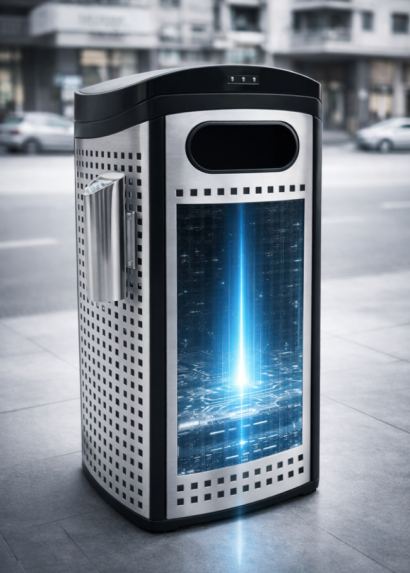
In smart cities, some of the most concrete examples of capacitive sensing emerge in waste‑management applications, where monitoring the fill level of bins becomes more efficient when the measurement is discreet and can be integrated without exposed mechanical parts. A printed capacitive sensor, positioned inside the wall of the container, can detect variations in proximity and the presence of material, providing a signal useful for estimating the filling trend and enabling more targeted collection strategies. This contributes to localized detection and improves hygiene in urban environments.

The integration of IoT sensors makes it possible to turn raw data into actionable services such as route planning, reducing unnecessary collection rounds and identifying potential anomalies. In this context, smart sensors become an essential element for making urban infrastructure more responsive, traceable, and sustainable.